Manufacturing Management

Develop High-Tech, Hands-On Skills
Mid’s Manufacturing Management Pathway can help you launch or advance your career. Complete classroom hours for on-trend topics and techniques, earn an industry-recognized certification, and pursue a degree on a schedule you choose.
-
$99kMedian pay for Supply Chain Managers
-
670Michigan Annual Job Openings
-
3%Growth in Employment Opportunities
Mid’s AIM program emphasizes in-demand skills like welding and CNC programming alongside topics like communication and project management. Our flexible pathways let you choose what’s right for you:
- Currently working in manufacturing (or a military veteran)? Your experience can earn you college credit. No formal portfolio or interview required—just share your story and see what credits you’ve already earned.
- Just graduated from high school and not sure what career is the best fit? Explore manufacturing fields during your first year at Mid. Then choose the specialty that matches your interests.
Train in our newly renovated, high-tech labs on both campuses
- State-of-the-Art Facilities | CNC machining, 3D printing, robotics, and advanced technologies.
- Multidisciplinary Training | Hands-on learning across automation, programming, machining, and logistics.
- Career Outcomes | Flexible spaces designed for learning in-demand skills employers look for in today's workforce.
- Industry Certifications | NC3 and FANUC credentials that boost job readiness and strengthen employability.
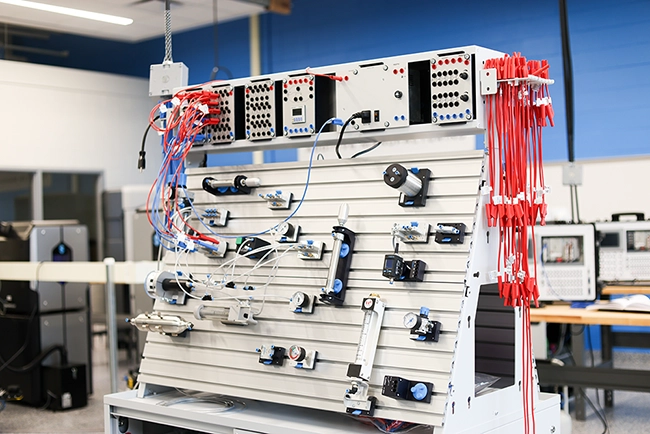
AIM classes are small, offering one-on-one attention. Our connections with area employers lead to internships or apprenticeships that can earn you journeyman status. And our open labs and online courses help you pursue your education while you’re working.
Manufacturing Management (Associate in Applied Science): Build on your skills and experience to advance your career. Become a leader ready to foster teamwork, ensure a safe work environment, and effectively leverage resources to deliver results.
More than 600,000 Michiganders work in manufacturing. Mid’s AIM program prepares you to join their ranks and find a fulfilling career.
Some facts from the National Association of Manufacturers:
- Manufacturers contributed $2.9 trillion (annualized) to the U.S. economy in the third quarter of 2022, an all-time high.
- Every $1 spent on manufacturing yields a $2.60 total impact on the overall economy.
- U.S.-manufactured goods exports totaled about $1.4 trillion in 2021.
- The manufacturing sector employed nearly 13 million workers in March 2023.
- There were 694,000 manufacturing job openings in February 2023.
- By 2030, the United States likely will need to fill 4 million manufacturing jobs.
- Manufacturing employees earned an average $95,990 in pay and benefits during 2021.
- 91% of manufacturing employees were eligible for health care benefits in 2022.
- Manufacturers perform more than 55% of all private-sector research and development.
AIM careers range from hands-on manufacturing roles to engineering positions that develop materials and product designs to support jobs in sales and more. Specific careers may require an associate degree or a bachelor’s degree:
Associate Degree Careers
- Manufacturing sales representatives: Median pay $30.29/hour or $63,000/year; estimated 2% growth in demand by 2031
Flexibility Balance school and work at the pace you choose.
Value Starting at Mid can save you over $16,000 off the cost of a bachelor’s degree.


In-Demand Certifications
Certifications from respected companies and organizations—Snap-on, Starrett, FANUC, American Welding Society, and more—boost your career potential by showing employers the skills you’ve mastered. Earn these certifications alongside your Mid degree or credential.
Mid is affiliated with NC3, the National Coalition of Certification Centers, a national network that develops certifications based on national skills standards. Certifications demonstrate hands-on experience with state-of-the-art tools.
Show you know how to perform precision measurements, the cornerstone of quality in products and services people rely on. Snap-on, Starrett, and NC3 combined their industrial expertise to certify hands-on training on instruments vital to engineering, manufacturing, aerospace, power generation, natural resources and more.
Earning this certification demonstrates proficiency with instruments and methods including:
- Tape and rule measurement
- Slide caliper measurement
- Gauge measurement
- Angle measurement
- Micrometer measurement
- Dial gauge measurement
Demonstrate experience with Snap-on’s advanced electrical monitoring equipment. This certification will offer you an edge in fields like automotive repair, transportation, wind power, manufacturing, HVAC, and robotics.
You’ll learn to solve problems using digital multimeters, from basic applications to advanced troubleshooting. You’ll build some of the most requested skills in the industry, including:
- Multimeter controls and operation
- Meter display readings and symbols
- Proper terminal connections
- Basic applications
- Troubleshooting techniques
- Hands-on operation for a range of Snap-on multimeter models
Get hands-on training with industrial control equipment—learn to use a PLC, specifics of the PLC programming environment, and programming languages. Certification covers:
- Control relays
- Basic design and operation
- PLC sections
- Input types
- Memory types
- Logic processing
- Output types
- Number systems
- Boolean functions
- Basic troubleshooting
Understand electricity and how to use it safely. Build, test, and troubleshoot AC/DC circuits and examine operating voltages and currents that impact circuit operation. You’ll learn about:
- AC/DC electrical currents
- Ohm’s Law
- Kirchhoff’s voltage and current laws
- Measuring instruments
- Solving series and parallel circuits
- Electromagnetism
- Electrical distribution
- Troubleshooting electrical circuits
- Common electrical components
Learn about construction, operation, and maintenance of hydraulic components, including fundamental principles and valves controlling pressure, flow, rate, sequence, and direction. Practical exercises cover topics like:
- Reading and interpreting basic hydraulic circuit diagrams
- Understanding basic physical principles of hydraulics
- Measuring volumetric flow and pressure
- Understanding structure and operation of basic components
- Understanding technology and characteristics of valves and drive elements
- Setting up systems in accordance with circuit diagrams
- Understanding basic fundamentals of proportional hydraulics
Show you’re ready to enter the workforce safely. Build a foundation in OSHA General Industry Standards, general industry principles, and areas of industry that present the most hazards.
Learn to handle programming responsibilities for FANUC robots.
Develop skills focused on FANUC robot vision and sensors.
Build entry-level experience with tool identification and standard safety procedures.
Mid incorporates AWS SENSE—a set of minimum standards and guidelines for welding education programs—into its welding curriculum, ensuring you’ll receive a consistent, comprehensive education. Completing SENSE Level I certification recognizes you as a skilled entry-level welder.

- Josh
